
Best Full Stack Developer Course in Bangalore with Placement
At the center of India’s Silicon Valley. The demand for skilled full stack developers is growing fast. If you want to learn a full stack developer course in Bangalore that truly prepares you for real-world career opportunities, this institute provides a job-oriented training designed to transform beginners into industry-ready professionals.
Our full stack developer training in Bangalore is useful for freshers, working professionals, and career switchers, non-IT professionals who want to build modern web applications from scratch to learn. The syllabus covers in-demand technologies, including HTML, CSS, JavaScript, React or Angular, Node.js, Express, MongoDB, REST APIs, Git, and deployment—aligned with current IT industry standard skills in Bangalore.
Whether you prefer classroom training or flexible online learning, our full stack developer course online in Bangalore provides hands-on training, real-time projects, and IT expert guidance. At Ariyalam, we bridge the gap between basic coding knowledge and building scalable, enterprise-level applications—helping you become a more confident, job-ready developer.
Why Choose a Full Stack Developer Career in Bangalore?
Bangalore is India’s technology capital, home to thousands of startups, product companies, and global IT firms. As a Full Stack developer course in bangalore, you will be in high demand across e‑commerce, SaaS, fintech, and enterprise software companies.
Full Stack Developer Course Fees in Bangalore
₹40,000 ₹35,000
Key Features
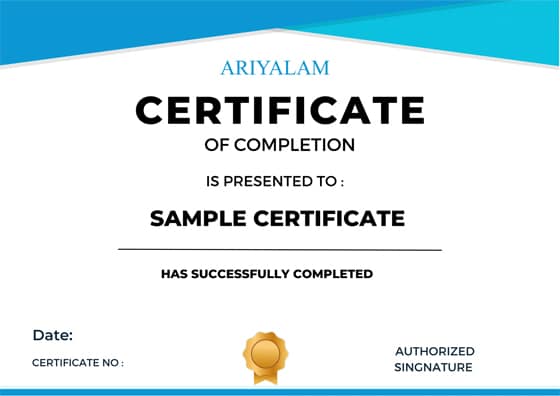
Full Stack Developer Certification
Key Features
Full Stack Developer Certification
Trainer Profile – IT Industry‑Experienced
Our trainers are practicing IT software engineers with real‑time experience in product and service MNC companies.
- 3 to 5+ years of industry experience in full stack and web development
- Currently working professionals handling a real-time live project.
- Job interview‑oriented teaching style focused on practical-oriented coding and debugging errors.
- Personalized doubt‑clarifying sessions and project guidance.
You will interact with trainers who understand what Bangalore‑based companies expect in coding tests, system design, and day‑to‑day development workflows. This makes our Full Stack Development Training in Bangalore ideal, whether you are a beginner or an experienced working professional upskilling.
Salaries for Full Stack Developer
After completing this training, you will be ready for attractive job opportunities with competitive pay.
Average Salary Range
- Fresher (0–1 year):₹3–4.5 LPA
- 1–3 years’ experience:₹5–9 LPA
- 4+ years’ experience:₹8–13+ LPA
Full Stack Developer Course Syllabus
HTML5 and CSS3
HTML Basics
- Basic tags: headings, paragraphs, links, lists, and images
- New HTML5 tags
- Forms and validations
- Local storage and IndexDB for storing data in the browser
CSS3 Basics
- CSS syntax and selectors
- Styling elements: colors, borders, margins, padding
- CSS3 properties: gradients, shadows, and rounded corners
- Animations and transitions
- Tooltips, flexbox, and CSS grid for layout
CSS Framework: Bootstrap
- Setting up and using Bootstrap for responsive design
- Layouts with Bootstrap grid
- Using Bootstrap components like navigation bars, buttons, modals
2. JavaScript and jQuery
JavaScript Basics:
Getting Started
- Introduction to JavaScript: variables, data types, operators, and expressions
- Functions, parameters, and return values
- Flow control: if statements, loops, switch cases
JavaScript Essentials
- Objects, arrays, and common methods (sort, filter, map)
- Functions: hoisting, closures, and scope
- Error handling and debugging
Working with the DOMs
- Selecting and modifying HTML elements
- Adding and removing elements dynamically
- Event handling (clicks, mouseover, etc.)
- Introduction to the Browser Object Model (BOM): window, screen, location, history, cookies
JavaScript and JSON
- Data types in JSON
- Parsing and stringifying JSON data
- Using JSON in AJAX and API calls
JavaScript vs. jQuery
- Basics of jQuery: selectors, events, and animations
- DOM manipulation with jQuery
- AJAX calls with jQuery
3. AJAX and Asynchronous Programming
AJAX Fundamentals
- XMLHttpRequest and Fetch API for asynchronous data loading
- Promises and async/await for handling asynchronous tasks
- Working with APIs and fetching data
4. Angular
Modern Front-End Framework
Getting Started with Angular
- Introduction to Angular and key features
- Setting up an Angular project and basic project structure
- Components, modules, and services
Angular Essentials
- Data binding: one-way and two-way
- Pipes for data transformation
- Directives (ngIf, ngFor, ngSwitch) for conditional rendering
Forms in Angular
- Template-driven and reactive forms
- Form validation and error handling
Angular Services and HTTP Client
- Creating and injecting services
- Using HTTP Client for API calls
- Observables and RxJS
Routing and Navigation
- Defining routes and navigating between components
- Route guards and lazy loading
Building & Deployment
- Building Angular apps with ng build
- Deploying an Angular app
5. Databases
Database Essentials for Full Stack Development
MongoDB (NoSQL Database)
- Introduction to MongoDB and NoSQL concepts
- Basic CRUD operations (Create, Read, Update, Delete)
- Mongoose for schema-based data modeling
- Indexing, aggregation, and connecting MongoDB with Node.js
MySQL (Relational Database)
- Basics of MySQL and SQL queries
- CRUD operations and managing relationships
- Connecting to MySQL from Node.js using the MySQL library
6. Node.js and Express
Back-end development with JavaScript
Node.js Basics
- Setting up Node.js and using Node Package Manager (NPM)
- Core concepts: asynchronous programming, event loop, and callbacks
- File system, buffers, and managing modules
Express Framework
- Setting up Express for handling server requests and responses
- Routing, middleware, and creating RESTful APIs
- Using JSON for API responses and data handling
Template Engines and Views
- Introduction to template engines (e.g., EJS)
- Creating dynamic views with templating
File Handling in Node.js
- Reading and writing files
- Asynchronous file operations
WebSocket’s and Real-Time Communication
- Setting up Socket.io for real-time communication
- Building a simple chat application with Express and Socket.io
7. Building Full-Stack Projects
Putting It All Together
Basic CRUD Applications
- Building CRUD operations (Create, Read, Update, Delete) with Node.js and MongoDB
- Integrating front-end with Angular or React
Authentication and Authorization
- Using JSON Web Tokens (JWT) for secure authentication
- Implementing roles and permissions for protected routes
- Handling exceptions and using implicit objects in JSP
- MVC pattern implementation in JSP
Deployment
- Deploying applications to cloud platforms (e.g., Heroku, AWS, or DigitalOcean)
- Environment management and setting up production configurations
8. PHP Essentials (Optional)
Introduction to Server-Side Scripting with PHP
- Basics of PHP and setting up a PHP server
- PHP and MySQL for database operations
- Basic CRUD operations with PHP
FAQ (Frequently Asked Questions)
1. Why is Ariyalam the best institute for Full Stack Developer training in Bangalore?
Ariyalam offers expert mentors, hands-on projects, industry-aligned curriculum, and 100% placement support — making it the top choice for Full Stack training in Bangalore.
2. Is a full stack web development course in Bangalore for freshers a good career choice?
Yes, a full stack web development course in Bangalore for freshers is an excellent career choice. With the growing demand for web applications, freshers can quickly enter the IT industry by learning both frontend and backend technologies at Ariyalam.
3. Are there full stack developer jobs in Bangalore for freshers?
Yes, there are plenty of full stack developer jobs in Bangalore for freshers. Many startups and IT companies are actively hiring skilled candidates. Completing training at Ariyalam improves your chances with real-time projects and placement assistance.
4. What is the future scope of full stack development?
The future of full stack development is very promising. Companies prefer developers who can handle both frontend and backend, making full stack developers highly valuable in startups and enterprises.
5. Why is full stack development in high demand?
Full stack development is in high demand because businesses want versatile developers who can build complete applications. This reduces hiring costs and improves efficiency, making full stack developers a top choice for companies.
6. How long does it take to become a full stack developer?
Typically, it takes around 3 to 6 months to become a job-ready full stack developer with proper training and practice. Ariyalam offers structured courses with flexible timing to help learners achieve this goal efficiently.
7. Which MNC companies offer full stack developer jobs in Bangalore, and do they hire freshers?
Top MNC companies like Infosys, TCS, Wipro, IBM, Accenture, Capgemini, and Cognizant offer full stack developer jobs in Bangalore. Product-based companies such as Microsoft, Oracle, and SAP also hire for these roles.
Yes, many of these companies hire freshers through campus placements, internships, and training programs. However, candidates need strong technical skills, hands-on project experience, and good problem-solving ability to get selected.
Enquiry Now