
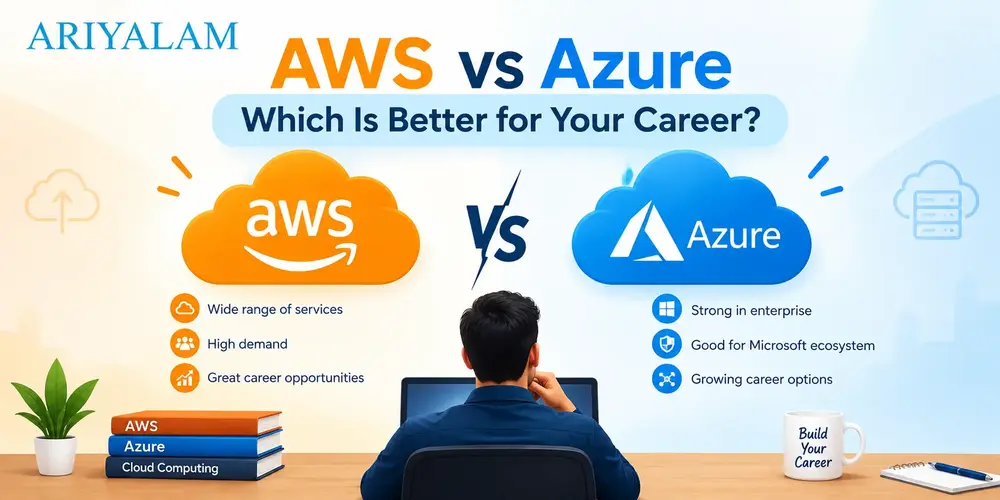
AWS vs Azure: Which Is Better for Your Career?
Today, cloud computing represents one of the key directions within the IT industry, which presents an opportunity to work in such areas as cloud engineer, DevOps specialist, solutions architect, developer, security specialist, etc. Among the popular platforms for cloud computing, we can find AWS and Microsoft Azure.
In case you plan your future career path within the cloud computing direction, you might wonder: AWS vs Azure: Which is better for my career? The answer will vary according to your background or goals and companies you want to work with and the kind of skills you want to obtain.
Currently, AWS represents a bigger share of the global cloud infrastructure market. On the other hand, Azure is widely represented among enterprises that have been using Microsoft technologies previously. According to Synergy Research Group, in Q1 2026 AWS held a market share of about 28-31%, and Microsoft – 23-25% worldwide.
Then what should you learn, AWS or Azure? Let’s see what is the difference between them from the career point of view.
What Is AWS(Amazon Web Services?
Amazon Web Services (AWS) is the cloud computing service provided by Amazon. It provides various types of services in the categories of computing, storage, databases, networking, security, analysis, machine learning, development and operation, and applications development.
Some examples of popular services of AWS are EC2 for computing, S3 for storage, VPC for networking, IAM for identity and access management, RDS for managed databases, and Lambda for serverless computing.
The usage of AWS has become prevalent amongst startups, technology companies, SaaS companies, enterprises, and application developers who use cloud native applications.
For people wanting to learn about the practical aspects of cloud computing, a training program in AWS course online can help.
What Is Microsoft Azure?
Microsoft Azure is a cloud computing platform by Microsoft. The services are available in domains including computing, storage, databases, networking, security, analytics, artificial intelligence, and application development.
Azure integrates very well with Microsoft’s technology stack which includes Windows Server, Microsoft 365, Active Directory, .NET and various other enterprise technologies.
Therefore, Azure becomes an ideal choice for companies already employing Microsoft technologies.
Azure services are widely adopted in all domains of business where matters such as security and compliance become an issue, such as enterprise IT, financial services, healthcare, government, consulting, and many others.
AWS vs Azure: Key Differences
AWS and Azure provide many similar cloud capabilities, although their services and terminology differ.
| Category | AWS | Azure |
| Compute | Amazon EC2 | Azure Virtual Machines |
| Storage | Amazon S3 | Azure Blob Storage |
| Database | Amazon RDS | Azure SQL Database |
| Serverless | AWS Lambda | Azure Functions |
| Identity | AWS IAM | Microsoft Entra ID |
| Containers | Amazon ECS / EKS | Azure Container Apps / AKS |
| AI | AWS AI services | Azure AI services |
The most important difference for your career is not simply the service names. It is the type of companies and technology environments where each platform is commonly used.
AWS vs Azure: Which Is Easy to Learn?
One of the most common beginner questions is Azure vs AWS which is easy to learn?
There is no universal answer.
AWS offers a huge range of services, and so it might be difficult at first for beginners due to the number of services and the specific terminology associated with AWS.
However, Azure may seem easy to learn for users that have knowledge of the Windows Server, Microsoft 365, Active Directory, or .NET technologies.
Therefore:
Choose AWS if:
- You want to build broad cloud knowledge.
- You are interested in startups and technology companies.
- You want to explore cloud-native and open-source environments.
- You want exposure to a large cloud ecosystem.
Choose Azure if:
- You already work with Microsoft technologies.
- You are interested in enterprise IT.
- You want to work with Windows, .NET, or Microsoft environments.
- You are interested in hybrid cloud and corporate infrastructure.
For a complete beginner, either platform can be a good starting point. Consistent practice matters more than choosing the platform that appears easiest.
AWS vs Azure Job Opportunities in the Future
The future seems very bright for both AWS and Azure because firms keep on making investments in cloud infrastructure, automation, AI, security, and data platforms.
AWS has a stronghold in start-ups, product firms, SaaS firms, IT firms, and cloud-native firms. Azure has a great adoption rate by firms and firms which are using Microsoft ecosystem.
Data from the present market also confirms that cloud market is growing at a very fast pace, and the major contributors are AI and generative AI.
Instead of asking only AWS vs Azure job opportunities in the future, consider the skills employers expect alongside cloud knowledge.
Important complementary skills include:
- Linux
- Networking
- Cloud security
- Docker
- Kubernetes
- Terraform
- CI/CD
- Git
- Python
- Monitoring and automation
This is why cloud and DevOps skills often work well together. Learners interested in deployment, automation, and infrastructure can also explore an Online DevOps Course.
AWS vs Azure: Career Opportunities
Both platforms can lead to similar career paths.
AWS Career Roles
AWS professionals can work as:
- AWS Cloud Engineer
- AWS Solutions Architect
- DevOps Engineer
- Cloud Administrator
- Cloud Security Engineer
- Cloud Developer
AWS can be particularly attractive if you want to work with technology companies, startups, SaaS businesses, or cloud-native environments.
Azure Career Roles
Azure professionals can work as:
- Azure Administrator
- Azure Cloud Engineer
- Azure Solutions Architect
- Azure Developer
- Azure Security Engineer
- DevOps Engineer
Azure can be a strong choice for professionals targeting enterprise environments, Microsoft-based organizations, banking, consulting, and large corporate IT teams.
AWS Certification vs Azure Certifications
It will assist in showing your expertise in cloud computing technology; however, certification alone cannot lead you to get a job. Practical knowledge and skillsets play an important role as well.
Currently, AWS offers four types of certifications: Foundational, Associate, Professional, and Specialty. AWS suggests selecting the path of certification according to your background, roles, and career goals.
If you are new to the world of cloud computing, AWS Certified Cloud Practitioner is an option for you before going for the role-based certification.
Similarly, Microsoft offers role-based certifications for Azure. Azure Fundamentals certification will give you a basic idea about cloud computing and its services, and it is considered an initial step for cloud professionals.
The main thing that one should keep in mind is not to gather all certifications without knowledge and practicality. Make sure to work on some projects while getting AWS or Azure certifications.
Is AWS or Azure Better for a Career in India?
Both platforms offer strong career potential in India.
AWS may be a better choice if your priority is a wider range of cloud and technology roles. Azure may be especially attractive if you want enterprise-focused roles involving Microsoft technologies.
Your choice should also depend on your target job description. Search for the roles you want and check whether employers frequently ask for AWS, Azure, or both.
In the long term, learning one platform deeply and then developing basic knowledge of the other can be a practical strategy. Multi-cloud knowledge can help you understand how similar cloud concepts are implemented across different platforms.
Which One Should You Learn First?
If you are completely new to cloud computing, start with the platform that matches your career goal.
Start with AWS if you want:
- Broad cloud exposure
- Startup and product-company opportunities
- Cloud-native experience
- A large ecosystem of cloud services
Start with Azure if you want:
- Enterprise IT opportunities
- Microsoft-based environments
- Hybrid cloud experience
- Roles involving Windows and .NET technologies
You do not need to learn AWS and Azure simultaneously as a beginner. Build a strong foundation in one platform first and expand later.
Conclusion: AWS vs Azure – Which Is Better for Your Career?
So, AWS vs Azure: Which Is Better for Your Career?
There is no single winner for every learner.
Currently, AWS enjoys an edge in overall market share in the world of cloud infrastructure market share, while Azure remains a formidable force in the enterprise and Microsoft environments.
If you are interested in exposure in the wide world of clouds, AWS is a great choice for you.
If you are interested in enterprise IT, Microsoft technologies, hybrid clouds, and large enterprises, Azure is a great choice for you.
Instead of making yourself limited by picking AWS or Azure, the right approach would be to focus on fundamentals of cloud computing, networking, Linux, security, automation, and DevOps. You can then supplement this knowledge with certifications and projects.
Ariyalam can assist you with your cloud journey by teaching you skills through online IT courses.
Frequently Asked Questions
1. Which company offers better career opportunities, AWS or Azure?
Career Prospects for both AWS and Azure are great. AWS enjoys wide adoption from startups to MNCs, technology companies, and cloud native firms whereas Azure is more suited to enterprises. The career prospects will depend on your skill set, experience, geography, and job position you are interested in.
2. Which is better to learn, Azure or AWS?
AWS might be the right choice for you if you wish to learn about cloud in general as well as get exposure in technology companies. Azure will be more suitable if you have Microsoft based knowledge or you are looking for enterprise roles. Master one platform first and then start learning about the other one.
3. Is Azure a high-paying job?
Having expertise in Azure can help you land a highly paid job as Azure Cloud Engineer, Solutions Architect, DevOps Engineer, and Cloud Security Engineer. However, earning high salary will depend upon experience, technical skills, certification, projects, geography, and employer not just Azure knowledge.
4. Will Azure overtake AWS?
It is very difficult to make an estimate as to which one of them will be the top choice in the future. AWS has the edge when it comes to global cloud infrastructure market share whereas Azure is growing fast.