
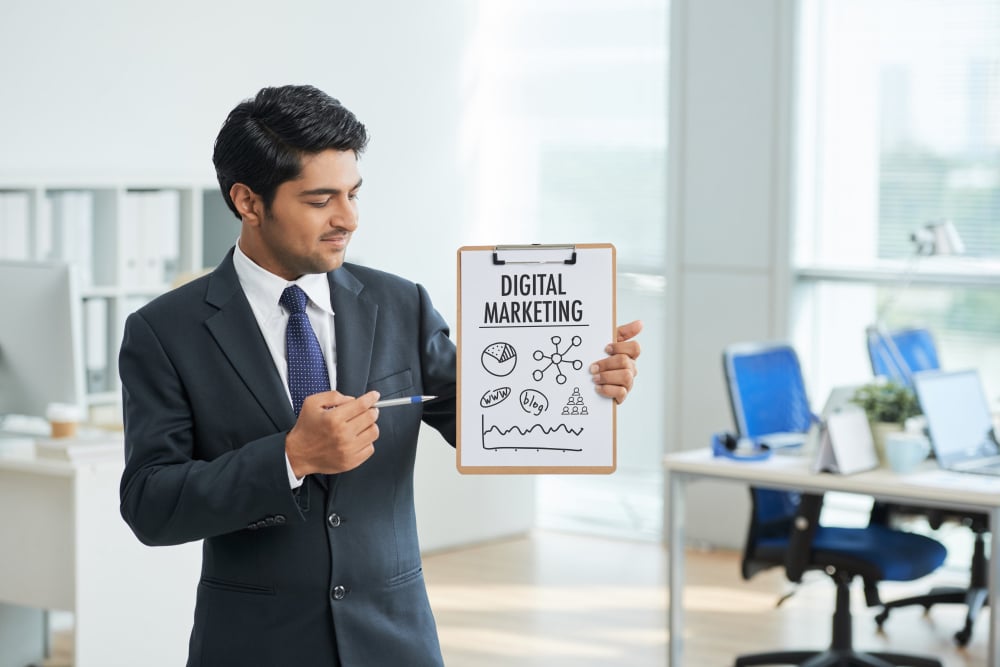
Marketing through digital media is one of the most crucial elements in helping the business promote itself in order to attract customers, create brand awareness, generate leads, and increase the sales of the product.
If you are a student who is wondering which career path to choose, a businessman who wishes to promote his products, or simply an individual who does not know where to start from as far as digital marketing goes, then learning about the basics is the first step towards success.
In this guide on digital marketing for 2026, you can find all the information that you require regarding digital marketing – its definition, working principles, various types, advantages and disadvantages, examples, and many other things.
Quick Answer: What Is Digital Marketing?
Definition of digital marketing
It refers to the marketing of products or brands through digital media such as websites, search engines, social media, emails, mobile applications, online advertisements and more.
The aim of any business to target a specific audience, build brand awareness, generate leads and evaluate the performance of its campaigns is achieved through digital marketing.
In case a company manages to rank itself on Google through SEO, runs a Google Adwords campaign, uploads a promotional video on Instagram, sends an email newsletter or makes use of artificial intelligence software for marketing campaigns, then it is considered digital marketing.
What Is Digital Marketing?
Digital marketing or online marketing is referred to as the process whereby the promotion of any business, product, service, or a brand is done via digital means.
Unlike the conventional ways of marketing through which mediums like newspapers, TV, radio, and even hoardings were used, digital marketing has facilitated the way in which the business organizations can communicate to their audience via digital means.
The major objective of digital marketing is to reach the right audience with the right message.
For example, a training institute can:
- Rank its course pages on Google using SEO.
- Run paid advertisements for students searching for courses.
- Share educational content on Instagram and LinkedIn.
- Send course updates through email.
- Use YouTube videos to explain career opportunities.
- Track website visitors and enquiry conversions using analytics. This combination of channels helps businesses create a measurable and targeted marketing strategy.
Digital Marketing Meaning in Simple Words
In essence, digital marketing is about using the internet and other digital means to market a product or service.
Suppose you search for a service on Google and visit a website. Afterward, you get advertisements for the same service on social media. This is followed by an email or even watching a YouTube video of the same.
This is an example of digital marketing.
The most distinctive feature in this case is that the companies can trace the actions of the customers in their journey, which includes:
- Website visits
- Ad clicks
- Form submissions
- Leads
- Purchases
- Email engagement
- Social media interactions
This data helps marketers improve future campaigns.
How Does Digital Marketing Work?
Digital marketing consists of the process of finding an audience, selecting digital channels, creating the right content, and then evaluating the outcome.Regardless of the unique approach each company adopts, the process often involves the following procedure.
1. Identify the Target Audience
This is followed by identifying the intended audience.
A target audience can be identified based on the following characteristics:
- Age
- Location
- Interests
- Profession
- Online behaviour
- Problems or needs
- Purchasing intent
For example, a digital marketing course may target students, graduates, working professionals, business owners, and people interested in changing careers.
2. Choose the Right Digital Channels
The choice of media differs with each audience segment. A business might choose one medium or even a number of media.
Common channels include:
- Google Search
- Websites
- YouTube
- Mobile apps
- Online advertising platforms
The best channel depends on the audience and business goal.
3. Create Content and Campaigns
The next step is to produce relevant content in the form of advertisements, webpages, videos, emails, or social media posts.
The content should match the user’s needs and search intent.
For example:
- A blog can answer an informational question.
- A Google Ad can target users ready to take action.
- An email campaign can nurture existing leads.
- A video can demonstrate a product.
- A social media campaign can increase brand awareness.
4. Generate Leads and Conversions
Digital marketing campaigns often guide users toward a specific action.
This action may include:
- Filling out a contact form
- Calling a business
- Downloading a guide
- Registering for a course
- Making a purchase
- Subscribing to a newsletter
When a user completes a desired action, it is generally called a conversion.
5. Measure and Optimize Performance
One of the important features of digital marketing is measurability.
Marketers can track metrics such as:
- Website traffic
- Click-through rate
- Conversion rate
- Cost per lead
- Engagement
- Return on investment
- Email open rate
- Keyword rankings
Based on this data, campaigns can be improved over time.
Types of Digital Marketing
Types of digital marketing are numerous, and companies do not stick to a single medium but prefer a combination of different techniques.
1. Search Engine Optimization (SEO)
Search Engine Optimization, abbreviated as SEO, involves making changes to the website so that it has increased visibility in search engine results pages.
SEO may include:
- Keyword research
- On-page optimization
- Technical SEO
- Content optimization
- Link building
- Local SEO
For example, an organization could create a useful page with the help of a keyword, such as “digital marketing course in Bangalore,” and optimize it for bringing organic traffic to the site.
The benefits of SEO include that it allows organizations to bring visitors who are looking for specific information, products, or services.
2. Pay-Per-Click Advertising (PPC)
PPC is a type of paid advertising that involves paying the advertiser when people click on the advertisement.
Popular PPC platforms include:
- Google Ads
- Microsoft Advertising
- Meta Ads
- LinkedIn Ads
PPC can help businesses gain visibility quickly, especially for commercial or high-intent keywords.
3. Social Media Marketing
Social media marketing involves using social platforms to promote brands, engage audiences, distribute content, and support lead generation.
Common platforms include:
- YouTube
- X
Activities may include organic posts, short videos, community engagement, influencer collaborations, and paid advertising.
4. Content Marketing
Content marketing focuses on creating useful and relevant content that attracts and engages a target audience.
Common content formats include:
- Blog posts
- Articles
- Videos
- Case studies
- Infographics
- Guides
- Podcasts
- Webinars
Instead of focusing only on direct promotion, content marketing can help businesses build trust and demonstrate expertise.
5. Email Marketing
Email marketing allows businesses to communicate directly with subscribers and potential customers.
Common email campaigns include:
- Newsletters
- Welcome emails
- Promotional campaigns
- Course updates
- Product announcements
- Lead nurturing sequences
Email marketing can be particularly useful for maintaining relationships with people who have already shown interest in a business.
6. Affiliate Marketing
Affiliate marketing involves marketing someone else’s products or services through individual or organizational marketing and receiving remuneration according to the pre-agreed results.
For instance, a blogger may market a product through an affiliate link and receive a commission whenever there is a sale.
7. Influencer Marketing
Influencer marketing involves collaborating with creators or individuals who have an established audience.
Businesses may work with influencers to:
- Introduce products
- Create reviews
- Improve brand awareness
- Reach niche audiences
- Generate social proof
The effectiveness depends on factors such as audience relevance, credibility, campaign quality, and transparency.
8. Video Marketing
Video marketing uses visual content to educate, entertain, demonstrate, or promote.
Examples include:
- YouTube videos
- Instagram Reels
- Product demonstrations
- Tutorials
- Customer testimonials
- Live videos
- Educational videos
Video can make complex information easier to understand and can be distributed across multiple platforms.
9. Mobile Marketing
Mobile marketing focuses on reaching users through smartphones and other mobile devices.
Common methods include:
- SMS marketing
- Mobile advertising
- App notifications
- Mobile-friendly websites
- WhatsApp communication
Since many users access websites and digital platforms through mobile devices, mobile optimization is an important part of an overall digital strategy.
10. Marketing Automation
Marketing automation uses software and technology to automate repetitive marketing activities.
Automation may be used for:
- Email sequences
- Lead nurturing
- Audience segmentation
- Campaign scheduling
- Customer follow-ups
- Reporting
Automation can save time, but campaigns still require strategy, monitoring, and optimization.
11. Answer Engine Optimization (AEO)
AEO refers to Answer Engine Optimization. It is a practice which emphasizes making your content more understandable by answering engines.
AEO strategies may include:
- Answering questions clearly.
- Using descriptive headings.
- Creating concise definitions.
- Adding relevant FAQs.
- Structuring information logically.
- Using appropriate structured data where relevant.
For example, a section that directly answers “What is digital marketing?” near the beginning of an article can improve clarity for users and answer-oriented search experiences.
12. Generative Engine Optimization (GEO)
GEO stands for Generative Engine Optimization and is a developing technology that focuses on improving the interpretability, representation, and possible visibility of content in generative AI-based search and answers environments.
GEO generally emphasizes:
- Clear and accurate information
- Demonstrated expertise
- Strong topical coverage
- Original insights
- Well-structured content
- Trustworthy sources
- Consistent brand information
GEO should not replace SEO. Instead, businesses can think of SEO, AEO, and GEO as complementary approaches to improving discoverability across different search and information experiences.
Digital Marketing Channels Explained
Digital marketing channels are the platforms and methods businesses use to communicate with audiences.
Search Engines
Search engines help users discover information, products, and services. Businesses can gain visibility through organic search optimization and paid advertising.
Websites and Landing Pages
A website often acts as a central destination for digital marketing activities. Visitors from search engines, ads, social media, or email campaigns may be directed to relevant pages.
Social Media Platforms
Social platforms allow businesses to publish content, interact with audiences, build communities, and run advertising campaigns.
Email provides a direct communication channel for newsletters, promotions, updates, and lead nurturing.
Video Platforms
Platforms such as YouTube and short-form video platforms can be used for tutorials, demonstrations, brand storytelling, and educational content.
Mobile Apps and Messaging
Mobile apps, SMS, push notifications, and messaging platforms can help businesses communicate with customers more directly.
Online Advertising Networks
Businesses can use advertising networks to display search ads, video ads, display advertisements, remarketing campaigns, and other promotional content.
Key Features of Digital Marketing
The major features of digital marketing include:
- Reaches desired target audience: Campaigns may target specific audiences.
- Performance tracking: It is possible to track clicks, traffic, leads, and conversions.
- Optimization: Campaigns may be optimized based on their performance.
- Multi-channels: Businesses can utilize search engines, social media, emails, videos, etc.
- Personalization: The messages can be personalized for different target audiences.
- Geographical reach: Business has an option to reach people across various geographies.
- Scalable: Campaigns can be scaled up as per budgets and business needs.
Benefits of Digital Marketing
Digital marketing provides several advantages for businesses of different sizes.
1. Reach a Larger Audience
Businesses can reach potential customers beyond their immediate physical location.
2. Target Specific Audiences
Marketing campaigns can often be customized based on location, interests, behaviour, demographics, or search intent.
3. Cost-Effective Marketing
In digital marketing, there is flexibility for companies on how they can distribute their marketing budgets. It allows small businesses to begin their marketing efforts using either content marketing, SEO, or social media marketing.
4. Measurable Results
The use of analytics software makes it feasible to track the effectiveness of campaigns and know what is working.
5. Better Brand Awareness
Consistent content and digital visibility can help more people discover and remember a brand.
6. Lead Generation
Businesses can use websites, landing pages, advertisements, forms, and content to attract potential customers.
7. Improved Customer Engagement
Social media, email, messaging, and other channels allow businesses to communicate directly with their audiences.
Digital Marketing Advantages and Disadvantages
Like any marketing approach, digital marketing has both advantages and challenges.
Advantages of Digital Marketing
- Can reach targeted audiences.
- Offers measurable campaign data.
- Supports multiple content formats.
- Can be flexible for different budgets.
- Allows faster testing and optimization.
- Supports local, national, and international reach.
- Provides opportunities for personalization.
Disadvantages of Digital Marketing
- Competition can be high.
- Platforms and algorithms change frequently.
- Paid advertising costs can increase.
- Requires continuous learning and skill development.
- Data privacy and compliance must be considered.
- Poor targeting or strategy can waste budget.
- Audiences may experience advertising fatigue.
The key is not simply to use every digital channel. A successful strategy should focus on the channels that are most relevant to the business and its audience.
Digital Marketing Examples
Here are some simple examples of digital marketing in action.
Example 1: SEO
The training institute releases an informative article about job prospects and optimization of this article based on relevant keywords. The article reaches the users via Google, and further they browse the courses of the institute.
Example 2: Google Ads
The company conducts paid ads that reach users searching for that particular product or service.
Example 3: Social Media Marketing
The brand creates education reels and posts on Instagram to generate awareness and engage potential consumers.
Example 4: Email Marketing
The online business uses a personal recommendation approach by offering courses or products to previous subscribers of their newsletters.
Example 5: Video Marketing
The organization produces YouTube videos that show how their product resolves a certain customer need.
It is generally most effective for companies to utilize a number of mediums rather than use them separately.
Digital Marketing vs Traditional Marketing
| Digital Marketing | Traditional Marketing |
| Uses online and digital channels | Uses channels such as print, TV, radio, and outdoor advertising |
| Performance can often be measured quickly | Measurement may be more difficult depending on the channel |
| Supports audience targeting | Targeting may be broader |
| Campaigns can often be changed quickly | Changes may require more time and resources |
| Can use interactive content | Usually involves one-way communication |
| Includes search, social, email, and online advertising | Includes newspapers, magazines, television, radio, and billboards |
Traditional marketing cannot be said to be inefficient either since many organizations adopt both traditional and digital forms of marketing.
What Skills Do I Need for Digital Marketing?
You do not need to master every area at once. However, learning the following skills can provide a strong foundation.
SEO
Keyword research, search intent, on-page SEO, technical basics, and content strategy.
Google Ads and Paid Advertising
How paid ads work, from keywords to targeting to budget and conversion optimization.
Social Media Marketing
Content planning, audience engagement, social media marketing, and basic ad concepts.
Content Marketing
Skills in content research, copywriting, editing, content storytelling, and content strategy.
Marketing Analytics
Traffic analysis, conversions, engagement analysis, and ad campaign optimization.
Email Marketing
Audience segmentation, campaign planning, automation, and performance analysis.
AI and Digital Marketing Tools
AI tools can support research, content ideation, analysis, automation, and productivity. However, marketers still need to verify information, maintain quality, and apply strategic thinking.
Communication and Strategy
Strong communication, problem-solving, creativity, and analytical thinking are valuable across almost every digital marketing role.
How to Start Digital Marketing in 2026
If you are wondering how to start digital marketing, follow a structured approach.
Step 1: Learn the Fundamentals
Start by understanding:
- SEO
- Social media marketing
- Content marketing
- Google Ads
- Email marketing
- Analytics
You do not need to become an expert in every area immediately.
Step 2: Choose a Learning Path
Learning can be done using free materials, training, certification, projects, and blogs by the industry.
Structured courses on digital marketing can assist beginners to see how different channels work together.
Step 3: Practice on Real Projects
Create a small website, blog, social media page, or sample campaign.
Practical experience can help you understand:
- Keyword research
- Content creation
- Website optimization
- Campaign tracking
- Analytics
Step 4: Learn Digital Marketing Tools
Become familiar with tools related to:
- Analytics
- Keyword research
- SEO
- Advertising
- Social media management
- Email marketing
- Reporting
Step 5: Build a Portfolio
Document your work and results.
Your portfolio may include:
- SEO projects
- Blog content
- Social media campaigns
- Ad campaign examples
- Website audits
- Analytics reports
Step 6: Stay Updated
Digital marketing evolves consistently owing to advancements in technology, platform upgrades, artificial intelligence tools, privacy laws, and shifting customer behavior.
Continuous learning is crucial to a digital marketing profession.
How to Do Digital Marketing for a Business
Businesses can start with the following process:
- Define the business goal.
- Understand the target audience.
- Research competitors and customer needs.
- Build or improve the website.
- Select suitable marketing channels.
- Create helpful content.
- Run organic or paid campaigns.
- Track important metrics.
- Test and optimize campaigns.
- Improve the strategy based on data.
For instance, a training institute at the local level may use SEO, Google ads, education blogs, social media, email marketing, and testimonials from students to target prospective students.
What Is the Future of Digital Marketing?
Future trends in digital marketing will be characterized by the increased usage of AI, automation, personalization, data analytics, video, conversation, and advanced search technology.
Important areas to watch include:
- Artificial intelligence
- Generative AI
- SEO
- AEO
- GEO
- Marketing automation
- Personalization
- Video content
- Voice and conversational search
- Data privacy
- First-party data
However, technology cannot take away the importance of mastering good marketing basics. These include knowing your audience, solving their problems, creating helpful content, and evaluating performance.
How to Start a Career in Digital Marketing in 2026
Digital marketing offers opportunities for people with different educational and professional backgrounds.
Possible entry-level roles include:
- Digital Marketing Executive
- SEO Executive
- SEO Specialist
- Content Writer
- Social Media Executive
- PPC Executive
- Email Marketing Executive
- Marketing Analyst
As experience grows, professionals may specialize in a particular area or move into broader strategic roles.
To start building your career:
- Learn the fundamentals.
- Develop practical skills.
- Work on real or sample projects.
- Build a portfolio.
- Learn relevant tools.
- Stay updated with industry changes.
- Apply for internships, freelance projects, or entry-level roles.
Is Digital Marketing a Good Career?
A career in digital marketing is beneficial for someone who has an interest in technologies, marketing, communications, creativity, data analysis, and business growth.
There are several specialization options available in this field, such as SEO, paid marketing, social media marketing, content marketing, automation, and performance marketing.
But one’s career path in this field relies on skills, experience, problem-solving capabilities, portfolio, geographical location, company, specialization, and capability to change according to industry trends.
Instead of just earning a certificate in a course, beginners should try to build their skills and show their capabilities.
What Is a Digital Marketing Course?
A digital marketing course is a learning process that helps learn about the techniques and processes that are used for promoting businesses through the use of internet.
Depending on the course, topics may include:
- SEO
- Google Ads
- Social media marketing
- Content marketing
- Email marketing
- Analytics
- Website marketing
- Marketing automation
- AI tools
- Campaign strategy
The depth and practical coverage can vary between training providers.
If you want structured learning, explore Ariyalam’s Digital Marketing Course in Bangalore or its Online Digital Marketing Course to understand the available training options and course curriculum.
What Is the Digital Marketing Course Fees in India?
Digital marketing course fees in India can vary significantly depending on factors such as:
- Course duration
- Online or classroom format
- Course curriculum
- Trainer experience
- Practical projects
- Certifications
- Placement assistance
- Level of specialization
A beginner’s class may be cheaper than an advanced or specialized one.
Instead of comparing costs, you should compare the curriculum and practical aspects of education before enrolling in a class.
Questions to ask include:
- What topics are included?
- Will I work on practical projects?
- Which tools will I learn?
- Is the course suitable for beginners?
- Is mentorship available?
- Does the program include portfolio guidance?
Digital Marketing Course Salary and Career Growth
The salary after learning digital marketing can vary based on:
- Job role
- Experience
- Skills
- Location
- Company
- Portfolio
- Specialization
Skill building in various fields like SEO, paid ads, analysis, and social media can be beneficial for someone new to the industry and help with career advancement.
Experienced individuals can go for careers in the field of specialists, strategists, managers, consultants, or performance marketers.
Stop thinking about having a fixed salary post-completion of your course. Instead, concentrate on skill development.
Final Thoughts
Digital marketing is a very broad subject matter and it includes everything about technology, creativity, communications, strategies and analytics. Organizations may employ any form of digital marketing via SEO, social media, content, email marketing, paid marketing, and videos.
For those who are new in this area, the best route would be learning from the fundamentals, choosing a learning path and gaining experience through practical assignments.
With search and technology moving forward, some emerging trends like SEO, AEO, GEO, AI, automation, analytics, and personalization have become highly relevant. The basics however, remain the same – know your audience, provide them value, select the correct channel, measure your success and keep improving.
For the individuals who want to gain hands-on experience, Ariyalam‘s Digital Marketing Course will prove to be helpful, including Digital Marketing Course in Bangalore and Online Digital Marketing Course.
Frequently Asked Questions About Digital Marketing
1. What is digital marketing in simple words?
Digital marketing involves using digital channels to market or promote a product, service, or brand. These channels include search engines, websites, social media, emails, mobile applications, and online advertisements.
2. What are the main types of digital marketing?
Types include SEO, pay-per-click advertising, content marketing, social media marketing, email marketing, affiliate marketing, influencer marketing, video marketing, mobile marketing, and marketing automation.
3. How can I start digital marketing as a beginner?
You need to start by understanding SEO, content marketing, social media marketing, paid ads, email marketing, and analytics before practicing via actual or example projects to develop a portfolio.
4. What skills do I need for digital marketing?
Skills such as SEO, content generation, social media marketing, paid ads, analytics, communication, strategy development, and knowledge of relevant AI and marketing tools are beneficial.
5. What is the difference between SEO, AEO, and GEO?
SEO is geared towards enhancing search engine visibility. AEO entails creating structured content that addresses user inquiries effectively. GEO is a new form of marketing that centers on enhancing content visibility and representation within AI-powered search and answer experiences.
6. Is digital marketing a good career in 2026?
Career prospects for digital marketing can be very promising to those who possess practical skills and gain more experience, make a portfolio, and learn continuously as technology changes.
7. How much does a digital marketing course cost in India?
The digital marketing course cost in India differs depending on several factors like institute, course period, mode of delivery, and many others. Consider comparing the quality of the course and practical training before enrolling.